


hero.title
hero.learn_more
why_choose_us.badge
why_choose_us.title
why_choose_us.description
why_choose_us.description_br
why_choose_us.description_br
why_choose_us.cards.intellectual.title
why_choose_us.cards.intellectual.text
why_choose_us.cards.academic.title
why_choose_us.cards.academic.text
why_choose_us.cards.mathematical.title
why_choose_us.cards.mathematical.text
🔍 Why our resource? Because we transform the chaos of gambling into a structured encyclopedia of knowledge. Every article is the result of research from primary sources, historical documents, and classic game theory textbooks. Blackjack, roulette, baccarat, and poker are presented without myths — only verified logic and academic rigor.
🎓 Our readers include students, mathematics teachers, professional players (strictly for informational purposes), and curious minds who value depth over shallow advice. We explain basic strategy in blackjack, the history of card counting, and the mathematical foundation of the game — exclusively for educational purposes.
why_choose_us.academic_section.quote
🎯
why_choose_us.responsible_gaming.title
why_choose_us.responsible_gaming.text
why_choose_us.responsible_gaming.text
📐 Mathematical strategies & payout rates — detailed analysis of expected value, house edge, and optimal decisions in Blackjack, Poker, and European Roulette.
why_choose_us.math_resources.link
why_choose_us.cta.text
why_choose_us.cta.button
blackjack_intro.title
blackjack_intro.subtitle
blackjack_intro.text
variations.title
blackjack_math.badge
blackjack_math.title
blackjack_math.subhead
blackjack_math.ev.title
blackjack_math.ev.text
- blackjack_math.ev.points.0
- blackjack_math.ev.points.1
- blackjack_math.ev.points.2
blackjack_math.basic_strategy.title
blackjack_math.basic_strategy.text
- blackjack_math.basic_strategy.points.0
- blackjack_math.basic_strategy.points.1
- blackjack_math.basic_strategy.points.2
blackjack_math.house_edge.title
blackjack_math.house_edge.text
- blackjack_math.house_edge.points.0
- blackjack_math.house_edge.points.1
- blackjack_math.house_edge.points.2
blackjack_math.probability_deep_dive.title
blackjack_math.probability_deep_dive.text
1️⃣ Natural Blackjack Probability
Chance of being dealt a natural: ~4.83% (about 1 in 21 hands).
Chance of being dealt a natural: ~4.83% (about 1 in 21 hands).
2️⃣ Bust Probabilities
Standing on 12 busts ~31% if you hit; standing on 16 busts ~62%.
Standing on 12 busts ~31% if you hit; standing on 16 busts ~62%.
3️⃣ Dealer Bust Rate
Dealer busts approximately 28–35% of the time depending on upcard.
Dealer busts approximately 28–35% of the time depending on upcard.
4️⃣ Card Removal Effect
Each card dealt changes the remaining composition — the foundation of card counting.
Each card dealt changes the remaining composition — the foundation of card counting.
5️⃣ Standard Deviation
Per-hand standard deviation is ~1.14 betting units, making short-term variance high.
Per-hand standard deviation is ~1.14 betting units, making short-term variance high.
blackjack_math.key_statistics.title blackjack_math.key_statistics.subtitle
~0.5%
blackjack_math.key_statistics.items.edge
~4.83%
blackjack_math.key_statistics.items.natural_prob
~35%
blackjack_math.key_statistics.items.dealer_bust
~8%
blackjack_math.key_statistics.items.player_adv
📋 blackjack_math.basic_strategy.title Fundamentals blackjack_math.strategy_fundamentals.subtitle
blackjack_math.strategy_fundamentals.hard_hands.title
blackjack_math.strategy_fundamentals.hard_hands.text
Key rule: Always stand on hard 17+. Always hit on hard 11 or below. Double down on 11, on 10 against dealer 2–9, and on 9 against dealer 3–6.
blackjack_math.strategy_fundamentals.soft_hands.title
blackjack_math.strategy_fundamentals.soft_hands.text
Key rule: Soft 17 (A-6) should always be hit or doubled (never stand). Soft 18 (A-7) should be stood against dealer 2–8, doubled against 3–6, and hit against 9, 10, or A.
blackjack_math.strategy_fundamentals.pair_splitting.title
blackjack_math.strategy_fundamentals.pair_splitting.text
Golden rule: vegas_strip.strategy_table.values.never_split 10s (you already have 20!) or 5s (double down instead).
blackjack_math.rule_variations.title
blackjack_math.rule_variations.decks.title
blackjack_math.rule_variations.decks.text
blackjack_math.rule_variations.decks.note
blackjack_math.rule_variations.payout.title
blackjack_math.rule_variations.payout.text
blackjack_math.rule_variations.dealer_rules.title
blackjack_math.rule_variations.dealer_rules.text
🛡️
blackjack_math.surrender_insurance.title
vegas_strip.actions.terms.4: Available in some games, allowing you to forfeit half your bet. Late surrender is optimal against dealer 9, 10, or A with hard 14–16. This reduces the house edge by ~0.07%.
vegas_strip.actions.terms.5: When the dealer shows an Ace, you can bet half your stake that they have blackjack. The house edge on insurance is ~7.5% — never take it unless you are counting cards and the count is very high.
vegas_strip.actions.terms.6: Offered when you have a natural and the dealer shows an Ace. This is essentially insurance and should generally be declined unless counting.
EV(insurance) = P(dealer BJ) × 2 − [1 − P(dealer BJ)] = 3P(dealer BJ) − 1. At P(BJ) < 1/3, insurance is -EV.
blackjack_math.bankroll.title blackjack_math.bankroll.subtitle
blackjack_math.bankroll.flat_betting.title
blackjack_math.bankroll.flat_betting.text
blackjack_math.bankroll.progressive.title
blackjack_math.bankroll.progressive.text
blackjack_math.bankroll.kelly.title
blackjack_math.bankroll.kelly.text
blackjack_math.faq.title
blackjack_math.faq.q1.q
blackjack_math.faq.q1.a
blackjack_math.faq.q2.q
blackjack_math.faq.q2.a
blackjack_math.faq.q3.q
blackjack_math.faq.q3.a
blackjack_math.bottom_line.title
blackjack_math.bottom_line.tips.0
blackjack_math.bottom_line.tips.1
blackjack_math.bottom_line.tips.2
blackjack_math.bottom_line.tips.3
blackjack_math.bottom_line.tips.4
blackjack_math.bottom_line.tips.5
blackjack_math.bottom_line.quote
vegas_strip.title
vegas_strip.subtitle
vegas_strip.core_concept.title
atlantic_city.comparison_table.col_vs Blackjack is the quintessential American blackjack game. It is played with 4 standard 52-card decks. The goal is to beat the dealer's hand without exceeding 21. You are dealt 2 cards face up, the dealer receives 1 card face up and 1 card face down (hole card).
vegas_strip.core_concept.text2
vegas_strip.gameplay.title
vegas_strip.gameplay.text
🔹 Player Decisions
Starting from the left of the dealer, each player decides: Hit, Stand, vegas_strip.actions.terms.2, Split, or vegas_strip.actions.terms.4 (if available).
Starting from the left of the dealer, each player decides: Hit, Stand, vegas_strip.actions.terms.2, Split, or vegas_strip.actions.terms.4 (if available).
🔸 Dealer's Turn
After all players act, the dealer reveals the hole card and draws until reaching 17 or higher. Dealer stands on all 17s (including soft 17).
After all players act, the dealer reveals the hole card and draws until reaching 17 or higher. Dealer stands on all 17s (including soft 17).
🔹 Settlement
If you didn't bust and your total beats the dealer's, you win 1:1. A natural pays 3:2. If the dealer busts, all remaining players win.
If you didn't bust and your total beats the dealer's, you win 1:1. A natural pays 3:2. If the dealer busts, all remaining players win.
Key rules: Double down after split allowed. No re-splitting aces. Late surrender available.
vegas_strip.card_values.title
vegas_strip.card_values.text1
A "soft" hand contains an Ace counted as 11. A "hard" hand either has no Ace or the Ace is counted as 1. The flexibility of soft hands makes them strategically valuable.
⭐ Example: A-6 is a soft 17. If you hit and get a 5, you now have A-6-5 = 12 (hard 12, because counting the Ace as 11 would bust).
vegas_strip.actions.title
Hit
Stand
vegas_strip.actions.terms.2
Split
vegas_strip.actions.terms.4
vegas_strip.actions.terms.5
vegas_strip.actions.terms.6
vegas_strip.actions.terms.2: Double your bet in exchange for exactly one additional card. Best used when you have a strong advantage (11 vs dealer 6, 10 vs dealer 9, etc.).
Split: If your first two cards are the same rank, you can split them into two separate hands. Each gets its own bet. Aces often get only one additional card each.
🏆 blackjack_math.basic_strategy.title Overview
- 🔹 Hard Totals: Stand on 17+. Hit on 11 or less. Between 12-16, stand vs dealer 2-6, hit vs dealer 7-A.
- 🔸 Soft Totals: Stand on soft 19+. Hit soft 17 or less. Double soft 13-18 vs dealer 4-6.
- 🔹 Pairs: Always split Aces and 8s. vegas_strip.strategy_table.values.never_split 5s or 10s. Split 2,3,7 vs 2-7. Split 6 vs 2-6. Split 4 vs 5-6. Split 9 vs 2-9 except 7.
- 🔸 vegas_strip.actions.terms.2: 11 vs any dealer card. 10 vs dealer 2-9. 9 vs dealer 3-6. Soft 13-18 vs dealer 4-6.
- 🔹 vegas_strip.actions.terms.4: Hard 16 vs dealer 9, 10, A. Hard 15 vs dealer 10. Also 14 vs 10 and 7-7 vs 10 in some charts.
⭐ Memorizing basic strategy reduces the house edge to approximately 0.35–0.55% for atlantic_city.comparison_table.col_vs rules. This makes blackjack one of the best games for players in the casino.
vegas_strip.example.title
Scenario: You bet $10 and receive 10♠ 6♥ (hard 16). Dealer shows 9♣.
Decision: Basic strategy says to surrender (if available) or hit against dealer 9. You hit and receive 4♦ — now 10♠ 6♥ 4♦ = 20. You stand. Dealer reveals 7♦ (total 16) and draws 8♠ — busts with 24. You win $10.
Alternative: If you stood on 16, the dealer would have made 17 and you'd lose. Following basic strategy saved you!
vegas_strip.rule_variations.title
vegas_strip.rule_variations.favorable.title
vegas_strip.rule_variations.favorable.items.0
vegas_strip.rule_variations.favorable.items.1
vegas_strip.rule_variations.favorable.items.2
vegas_strip.rule_variations.favorable.items.3
vegas_strip.rule_variations.favorable.items.4
vegas_strip.rule_variations.favorable.items.5
vegas_strip.rule_variations.unfavorable.title
vegas_strip.rule_variations.unfavorable.items.0
vegas_strip.rule_variations.unfavorable.items.1
vegas_strip.rule_variations.unfavorable.items.2
vegas_strip.rule_variations.unfavorable.items.3
vegas_strip.rule_variations.unfavorable.items.4
vegas_strip.rule_variations.unfavorable.items.5
🎖️ House edge comparison: With S17, DAS, 4 decks, and late surrender — house edge ≈ 0.35%. With H17, no DAS, 8 decks, and 6:5 payout — house edge ≈ 2.5%. Always choose the best table conditions!
🏅 blackjack_math.basic_strategy.title Reference Table
| vegas_strip.strategy_table.col_hand | vegas_strip.strategy_table.col_dealer_weak | vegas_strip.strategy_table.col_dealer_strong |
|---|---|---|
| vegas_strip.strategy_table.rows.hard_17 | Stand | Stand |
| vegas_strip.strategy_table.rows.hard_13_16 | Stand | Hit |
| Hard 12 | vegas_strip.strategy_table.values.stand_vs_2_3_hit | Hit |
| Hard 11 | Double | vegas_strip.strategy_table.values.double_vs_a_hit |
| Hard 10 | Double (vs 2-9) | vegas_strip.strategy_table.values.hit_vs_10_a |
| Hard 9 | vegas_strip.strategy_table.values.double_vs_3_6 | vegas_strip.strategy_table.values.hit_vs_2_7_a |
| vegas_strip.strategy_table.rows.soft_19 | Stand | Stand |
| Soft 18 | Stand (vs 2,8) vegas_strip.strategy_table.values.double_vs_3_6 | vegas_strip.strategy_table.values.hit_vs_9_a |
| vegas_strip.strategy_table.rows.soft_17 | vegas_strip.strategy_table.values.double_vs_4_6_hit_vs_2_3 | Hit |
| vegas_strip.strategy_table.rows.aces_8s | Split | Split |
| 5s, 10s | vegas_strip.strategy_table.values.never_split | vegas_strip.strategy_table.values.never_split |
vegas_strip.strategy_table.note
european.title
european.subtitle
european.rules.title
european.rules.deal.title
navigation.european is typically played with 2 decks (sometimes 6 or 8). The key difference: the dealer receives only 1 card face up initially — no hole card. The dealer's second card is dealt after all players have completed their hands.
Critical rule: The dealer does not check for blackjack before players act. This means you can double down or split and then lose both bets if the dealer ends up with blackjack.
🔄 Key Differences from atlantic_city.comparison_table.col_vs
european.rules.key_differences.items.0
european.rules.key_differences.items.1
european.rules.key_differences.items.2
european.rules.key_differences.items.3
european.rules.key_differences.items.4
european.rules.key_differences.items.5
european.rules.special_rules.title
➜ En Prison / La Partage: Some European tables offer these rules for even-money bets when the dealer has blackjack. En Prison lets you leave your bet for the next hand; La Partage gives half your bet back. These rules significantly reduce the house edge.
➜ Double down after split is often restricted or unavailable in navigation.european.
⚡ The "No Hole Card" rule is the defining feature — navigation.european requires different strategic decisions because you cannot guarantee the dealer doesn't have a natural. Never insure a bad hand based on fear!
european.house_edge_comparison.title
navigation.european rules vary significantly by casino. The house edge can range from 0.35% (favorable rules with La Partage) to over 1% (restrictive rules without surrender).
| european.house_edge_comparison.col_rule_set | Decks | european.house_edge_comparison.col_edge | Notes |
|---|---|---|---|
| european.house_edge_comparison.row_best | 2 | ~0.35% | european.house_edge_comparison.note_best |
| european.house_edge_comparison.row_typical | 6 | ~0.62% | european.house_edge_comparison.note_typical |
| european.house_edge_comparison.row_restrictive | 8 | ~0.85%+ | european.house_edge_comparison.note_restrictive |
🧠 Strategic Adjustments for navigation.european
european.strategic_adjustments.no_hole.title
european.strategic_adjustments.no_hole.text
2️⃣ vegas_strip.actions.terms.2 Restrictions
european.strategic_adjustments.double_restrictions.text
3️⃣ No vegas_strip.actions.terms.4
european.strategic_adjustments.no_surrender.text
🧠 Golden rule for navigation.european: Be more cautious with doubles and splits against a dealer Ace or 10, since you'll lose all additional bets if the dealer has blackjack. Consider the "no peek" adjustment in your strategy.
european.beginner_mistakes.title
- european.beginner_mistakes.items.0
- european.beginner_mistakes.items.1
- european.beginner_mistakes.items.2
- european.beginner_mistakes.items.3
- european.beginner_mistakes.items.4
european.comparison.title
- American (atlantic_city.comparison_table.col_vs): Better for basic strategy players due to hole card and more favorable rules generally.
- European: La Partage rule can make it competitive when available. Single-deck European games can be excellent.
- european.comparison.conclusion
european.example_hand.title
EXAMPLE Your hand: 9♠ 2♥ (11). Dealer shows: A♣. European rules — no hole card.
european.example_hand.text1
Optimal play: In most European games, doubling 11 vs Ace is still mathematically correct if the dealer does not take your double on a blackjack (only original bet lost). But if you lose everything, hitting is safer.
atlantic_city.title
atlantic_city.subtitle
atlantic_city.subhead
🎴 navigation.atlantic is one of the most popular blackjack variants in the United States, standardized by the New Jersey Casino Control Commission. It is played with 8 standard decks and features several player-friendly rules that make it widely played and studied.
✨ Key features: Dealer stands on soft 17 (S17), double down after split (DAS) is allowed, late surrender is available, and you can re-split up to 3 times (4 hands total). These rules combine to create a game with a moderate house edge of approximately 0.35-0.45% with perfect basic strategy.
atlantic_city.rules_overview.title
- 8 decks are used, shuffled before each game or by continuous shuffling machine.
- Dealer receives 1 card face up and 1 card face down (American hole card style).
- Dealer peeks for blackjack if the upcard is an Ace or 10-value card.
- Dealer stands on soft 17 — a player-friendly rule worth ~0.2%.
- Double down after split (DAS) is allowed — adds ~0.14% to player advantage.
- Late surrender is available — forfeit half your bet after dealer checks for blackjack.
- You can re-split up to 3 times (maximum 4 hands). Aces can only be split once and receive one card each.
atlantic_city.late_surrender.title
Late surrender is a key feature of navigation.atlantic. Use it in these situations to reduce the house edge:
- Hard 16 vs dealer 9, 10, or A — surrender unless you have a composition that includes a 4 or 5 (hit those).
- Hard 15 vs dealer 10 — surrender. In some charts, also surrender 15 vs Ace.
- Hard 14 vs dealer 10 — some advanced charts recommend surrender here too.
- 7-7 vs dealer 10 — surrender (since splitting 7s against 10 is -EV and so is playing 14).
🔹 Why surrender is valuable: In these situations, your expected loss is greater than 50% of your bet. vegas_strip.actions.terms.4ing (losing 50%) is better than playing out the hand (losing ~54%+ on average).
atlantic_city.comparison_table.title
| Feature | atlantic_city.comparison_table.col_ac | atlantic_city.comparison_table.col_vs |
|---|---|---|
| atlantic_city.comparison_table.rows.decks | 8 | atlantic_city.comparison_table.values.decks_vs |
| atlantic_city.comparison_table.rows.s17 | ✅ Yes | ✅ Yes |
| atlantic_city.comparison_table.rows.das | ✅ Yes | ✅ Yes |
| Late vegas_strip.actions.terms.4 | ✅ Yes | atlantic_city.comparison_table.values.surrender_vs |
| atlantic_city.comparison_table.rows.resplit_aces | ❌ No | ❌ Usually no |
| european.house_edge_comparison.col_edge (blackjack_math.basic_strategy.title) | ~0.40% | ~0.35% |
| atlantic_city.comparison_table.rows.peek | ✅ Yes | ✅ Yes |
📌 atlantic_city.comparison_table.col_ac's 8-deck game has a slightly higher base house edge than 4-deck atlantic_city.comparison_table.col_vs, but the consistent player-friendly rules (S17, DAS, late surrender) keep it competitive.
atlantic_city.strategy_tips.title
- Use late surrender aggressively — it's one of your best tools in this variant.
- Double down on 11 vs all dealer upcards (except Ace, where you hit in some charts).
- Split 8s always — even against dealer 10 or A. Two hands of 8 are better than 16.
- Never take insurance — the house edge on insurance is ~7.5% regardless of variant.
- Split 2s and 3s only against dealer 2-7 — against 8-A, hit instead.
atlantic_city.example_hand.title
💡 Scenario: You are dealt 9♠ 7♣ (hard 16). Dealer shows 10♦. You check the basic strategy chart: surrender 16 vs 10. You forfeit half your bet and lose $5 instead of the ~$5.40 you would lose on average by playing. Over time, this 0.40 difference per hand adds up significantly!
🎴 Why atlantic_city.comparison_table.col_ac Rules Matter
navigation.atlantic represents a regulatory success story: the New Jersey Casino Control Commission mandated standardized, player-friendly rules across all casinos in atlantic_city.comparison_table.col_ac. This created a consistent and fair gaming environment where players could learn one strategy and use it everywhere. The inclusion of late surrender, DAS, and S17 makes this variant one of the most favorable for basic strategy players among multi-deck games.
✨ Many online casinos now offer "navigation.atlantic" as a specific game variant, making these rules accessible worldwide. The 8-deck game with CSM (continuous shuffler) is common, but the same strategy applies.
atlantic_city.terminology.title
- S17 – Dealer Stands on Soft 17
- DAS – atlantic_city.comparison_table.rows.das allowed
- Late vegas_strip.actions.terms.4 – vegas_strip.actions.terms.4 after dealer checks BJ
- CSM – Continuous Shuffling Machine
- Hole Card – Dealer's face-down card
- Natural – Two-card 21 (A + 10-value)
- Push – Tie with dealer (bet returned)
📌 Important Tips for atlantic_city.comparison_table.col_ac Games
- atlantic_city.tips.items.0
- atlantic_city.tips.items.1
- atlantic_city.tips.items.2
- atlantic_city.tips.items.3
- Some atlantic_city.comparison_table.col_ac casinos now offer 6:5 tables at lower minimums — always choose 3:2!
- Minimum bets are usually $10-$25 in atlantic_city.comparison_table.col_ac, but online versions can start as low as $1.
legends.title
legends.subtitle
The history of blackjack is as rich as the game itself. From its European origins as "Vingt-et-Un" (Twenty-One) in French casinos of the 1700s to the modern card-counting revolution, blackjack has evolved into the most mathematically studied casino game. Let's explore the legends who changed the game forever.
legends.intro.text2
legends.pioneers.title
- Edward O. Thorp (1962) — The father of card counting. His book "Beat the Dealer" proved mathematically that blackjack could be beaten. He developed the Ten-Count system and inspired a generation of advantage players.
- Julian Braun (1960s-70s) — IBM engineer who ran extensive computer simulations to refine basic strategy and counting systems. His work formed the foundation of modern Hi-Lo counting.
- Ken Uston (1970s-80s) — Famous for playing in teams and disguises. His book "Million Dollar Blackjack" detailed team play strategies. He won a landmark lawsuit establishing card counting as a legal mental skill.
- Stanford Wong (1970s-present) — Author of "Professional Blackjack" and "Blackjack Secrets". Creator of the "Wonging" technique — entering and leaving tables based on the count.
legends.mit_team.title
legends.mit_team.text
- Bill Kaplan — Harvard MBA who organized the team like a business, recruiting math prodigies from MIT.
- J.P. Massar — MIT student who helped develop the team's betting and signaling systems.
- Andy Bloch — MIT electrical engineer, later a professional poker player with multiple WSOP final tables.
- The Team's Legacy — Immortalized in the book "Bringing Down the House" by Ben Mezrich and the film "21". The team reportedly won over $10 million.
legends.modern_era.title
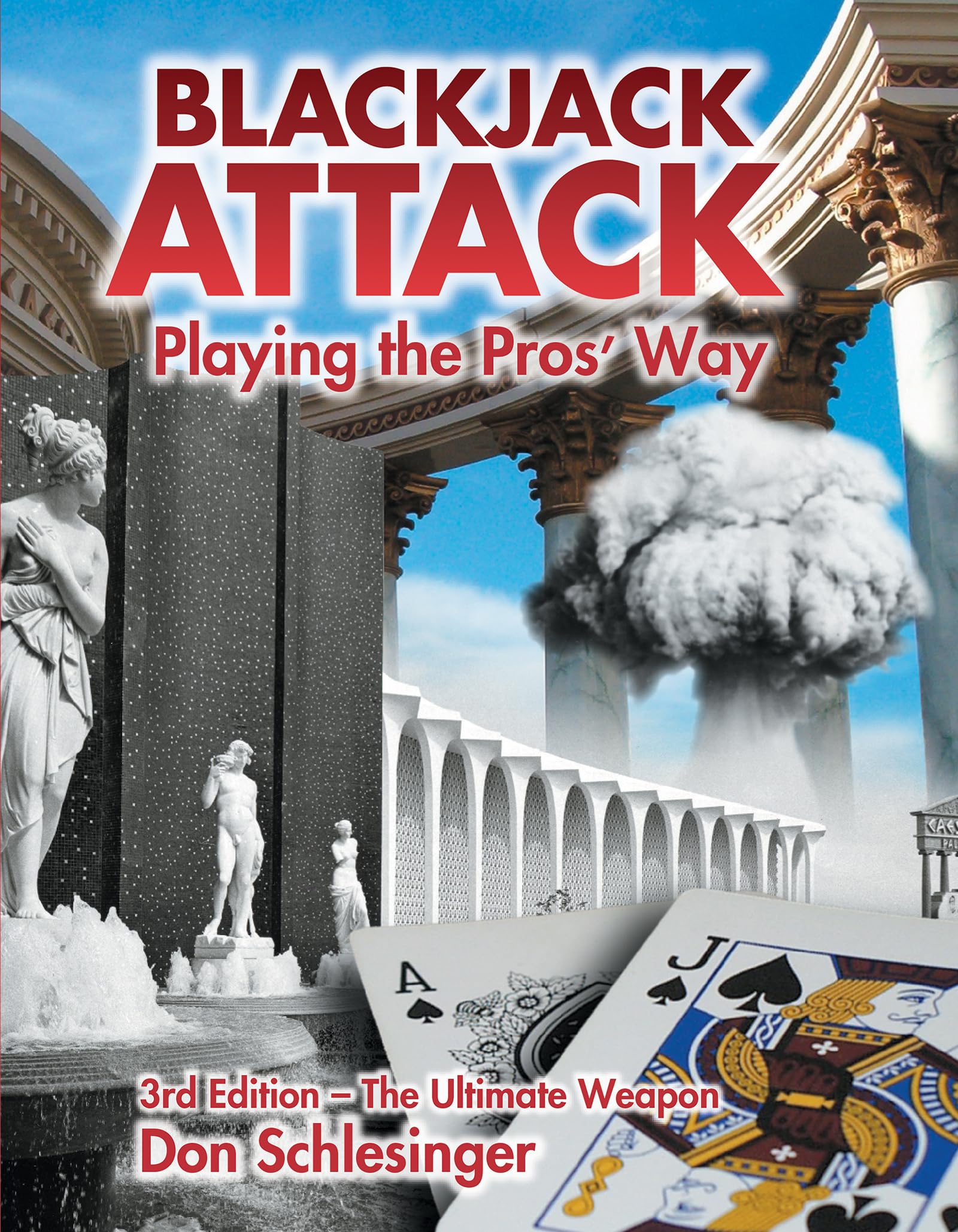
- Don Schlesinger — Author of "Blackjack Attack", the definitive text on blackjack mathematics including risk of ruin calculations and the Illustrious 18 (the most important card counting index variations).
- Arnold Snyder — Author and publisher of "Blackjack Forum" magazine. Known for his work on shuffle tracking and ace sequencing.
- Tommy Hyland — Manager of the longest-running blackjack team in history (since 1979). Known for exceptional discipline and longevity in the advantage-play world.
- James Grosjean — Author of "Beyond Counting", which detailed advanced advantage-play techniques including hole carding and shuffle tracking. Survived a casino detention that changed industry practices.
legends.essential_reading.title
- legends.essential_reading.books.0
- legends.essential_reading.books.1
- legends.essential_reading.books.2
- legends.essential_reading.books.3
- legends.essential_reading.books.4
legends.pop_culture.title
legends.pop_culture.text
calculator.title
calculator.tagline
A blackjack probability calculator is a tool that computes the win probability and expected value of any blackjack hand based on your cards, the dealer's upcard, and the remaining deck composition. It helps players understand the mathematically correct decision in every situation.
calculator.definition.highlight
calculator.how_it_works.title
Calculation principle: The calculator enumerates or simulates all possible outcomes given the current information.
- calculator.how_it_works.steps.0
- calculator.how_it_works.steps.1
- calculator.how_it_works.steps.2
- calculator.how_it_works.steps.3
- It also computes the expected value (EV) of each possible action: Hit, Stand, vegas_strip.actions.terms.2, Split, vegas_strip.actions.terms.4.
📈 Sample result for 16 vs 9:
Hit: EV = -0.540 (lose 54¢ per $1)
Stand: EV = -0.515 (lose 51.5¢ per $1)
vegas_strip.actions.terms.4: EV = -0.500 (lose 50¢ per $1) ← best option
Hit: EV = -0.540 (lose 54¢ per $1)
Stand: EV = -0.515 (lose 51.5¢ per $1)
vegas_strip.actions.terms.4: EV = -0.500 (lose 50¢ per $1) ← best option
calculator.features.title
calculator.features.cards.hand_input.title
calculator.features.cards.hand_input.text
calculator.features.cards.action_analysis.title
Compare EV for Hit, Stand, Double, Split, and vegas_strip.actions.terms.4 side by side.
calculator.features.cards.deck_comp.title
calculator.features.cards.deck_comp.text
calculator.features.cards.bust_prob.title
calculator.features.cards.bust_prob.text
calculator.features.cards.true_count.title
calculator.features.cards.true_count.text
calculator.features.cards.push_prob.title
calculator.features.cards.push_prob.text
calculator.practical_example.title
Situation: You hold 8♠ 7♥ (15) against dealer 10♣. Should you hit or stand?
The probability calculator shows:
🃟 Hit: 58% chance of busting, 22% win, 20% dealer bust
🃟 Stand: 77% dealer win rate, 23% win rate
📊 Verdict: Standing has a slightly higher EV on hard 15 vs 10 in most rule sets, but it's very close. Some charts say hit, some say stand.
🃟 Stand: 77% dealer win rate, 23% win rate
📊 Verdict: Standing has a slightly higher EV on hard 15 vs 10 in most rule sets, but it's very close. Some charts say hit, some say stand.
Takeaway: Hard 15 vs 10 is a borderline hand. The calculator shows why experts disagree — the EV difference is fractions of a percent.
calculator.types.title
| calculator.types.col_category | calculator.types.col_chars |
|---|---|
| Online basic strategy trainers (BlackjackInfo, Wizard of Odds) | calculator.types.trainers.desc |
| Probability calculators (BeatingBonuses, Qfit) | calculator.types.probability.desc |
| Card counting trainers (CV Blackjack, Blackjack Mentor) | calculator.types.counting.desc |
calculator.limitations.title
- Calculators assume infinite deck approximation unless you specify exact deck composition — this slightly affects edge calculations for double-down and split outcomes.
- In single-deck games, composition-dependent strategy matters: e.g., 16 vs 10 is different if your 16 is 10-6 vs 8-8 (since two 8s remove different cards from remaining deck).
- Calculators cannot account for betting strategy or bankroll management — they only show per-hand EV.
calculator.why_use.title
calculator.why_use.items.0
calculator.why_use.items.1
calculator.why_use.items.2
calculator.why_use.items.3
calculator.real_impact.title
Suppose you hold A♠ 7♣ (soft 18) against dealer 9♦. Many casual players stand because 18 "feels good." But a probability calculator shows standing has EV = -0.18 while hitting has EV = -0.14 (in 6-deck S17). You lose 4¢ less per dollar by hitting! Over 1000 hands, that's $40 saved. Small edges add up.
calculator.real_impact.note
calculator.ev_variance.title
Advanced blackjack players understand that every hand has an expected value. Sometimes the correct play still loses (short-term variance). But consistently choosing the highest EV action transforms you from a gambler into a mathematical player. A probability calculator is your roadmap to that transformation.
faq.title
faq.q1.q
faq.q1.a
faq.q2.q
faq.q2.a
faq.q3.q
faq.q3.a
faq.q4.q
faq.q4.a
faq.q5.q
faq.q5.a
faq.q6.q
faq.q6.a
faq.q7.q
faq.q7.a
contact.title
contact.text